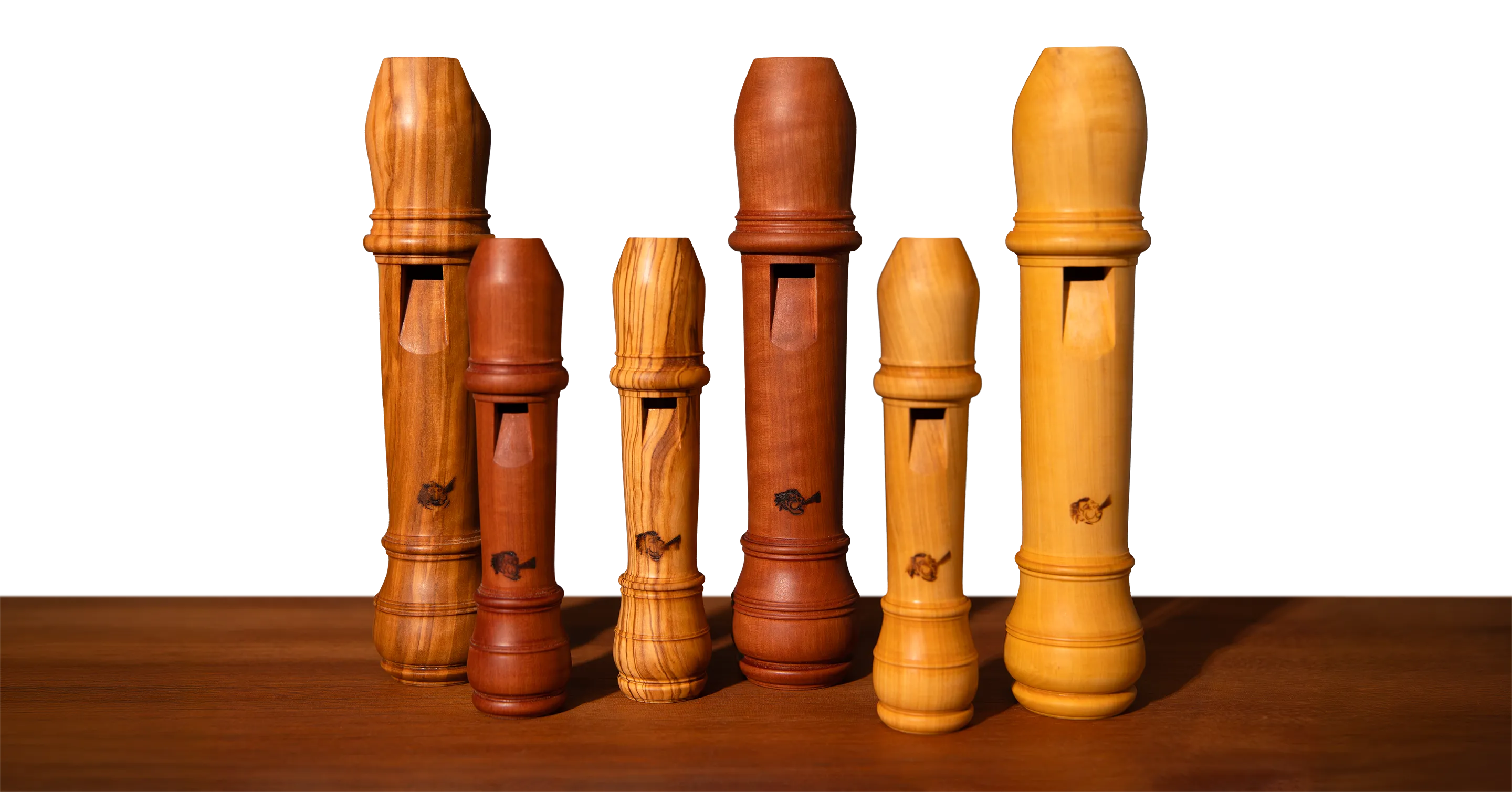
The main bore of a Baroque recorder or oboe is distinguished by its irregularly conical profile.
Put another way, the bore does not taper evenly but has steps — sections where the taper increases more sharply at certain points. These steps make it possible to control the octaves of one and the same note. It is one of the major discoveries in the making of Baroque wind instruments.
Even if the makers of the 17th and 18th centuries were perhaps already using reamers, which allow an irregular bore to be reproduced to a standard, they surely still often used spoon bits, which have to be handled with greater care.
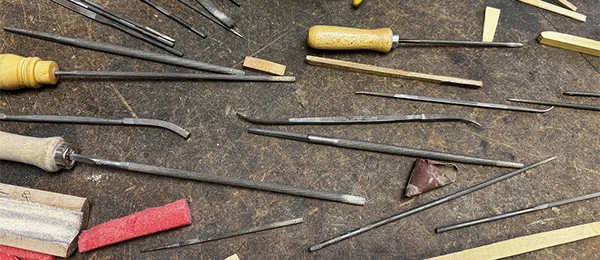
Today the majority of woodwind makers use reamers — a kind of bit that has the irregularly conical shape of the bore. These reamers take the form of a tapered cylinder of hard metal, which has to be turned to the correct shape and from which a quarter is milled away to obtain a cutting edge.
My reamers were made by my friend Xavier Plantevin. Xavier heads the metal workshop at the Geneva School of Art and Design (HEAD), where he has a high-precision CNC lathe at his disposal. Without Xavier I could not have made the recorders and oboes I make today.
Working from my drawings and my measurements, Xavier made my reamers with professionalism and his sense of precision — a concern for perfection, even — and quite uncommon care.